2017年11月18日 星期六

HUAWEI B315s-22 4G LTE WiFi Router Review

The Huawei B315s-22 is a 4G router for family use. Like its predecessor Huawei B593s-22, it allows sharing the 4G connection in WIFI with a valid SIM card from a network operator, and of course, the SIM card must has a data plan. Thus, in places where ADSL is of poor quality but 4G is available, it would be necessary to replace the ADSL and use the new Huawei B315s-22 with new contract from 4G network provider.


Huawei B315 4G Router


Huawei B315s-22 Technical Specifications


  • Height: 186mm Width: 139mm Depth: 46mm Weight: 275gram
  • Frequency bands: LTE/UMTS/GSM (4G LTE-FDD 800/900/1800/2100/2600MHz 4G LTE-TDD 2600MHz). However, frequency 700MHz is supported on band 28.
  • LTE Speed: Donwload up to 150Mbps / Upload up to 50Mbp
  • 2 SMA antenna jacks
  • 1 USB port
  • Wifi 802.11b/g/n
  • Supported number of wireless connections: Up to 32 devices
  • 4 Gigabit LAN ports/1 WAN/LAN port
  • 1 RJ11 port
  • Normal SIM card (no micro SIM or nano SIM, you may need an adapter if you use Micro SIM or Nano SIM.)


Huawei B315 4G Router2


Configuring Huawei B315s-22


The configuration of this type of router does not pose any difficulty. It is normally enough to insert the SIM, start the router, connect to the address http://192.168.1.1 after having connected to the B315 router's WIFI (name and wifi key available behind or below) and then launch the quick configuration in the interface (login name and password are both default as “admin”). This router is also controllable using the mobile application HUAWEI HiLink available on android or ios. User can manage the router settings from smartphones and Pads.


Huawei B315 LTE CPE


Our Opinion about Huawei B315


The Huawei B315s-22 is an excellent 4G router. The main difference with the HUAWEI B593s-22 is that it has better 4G reception, it only has one RJ11 port, it does not support the SIP protocol and it does not allow the router to use only the 4G. Thus, if the 4G/LTE signal is not very powerful, it switches itself in 3G or worse in 2G. However, you can connect an external 4G/LTE antenna to change this situation. You can connect a phone using the RJ11 jack (you need a T/Rj11 adapter if you have an old handset) to make calls using the sim card number 06 or 07 (If it is not just a data card).


For most cases, the Huawei B315s-22 is enough for most users with the support of LTE download speed to 150mbps and upload speed to 50mbps. But if there is LTE advanced or LTE-A pro network available, it’s also better to try the latest Huawei E525, Huawei E5186 or Huawei B618 Routers. We suppose one of them would definitely meet your demand for home or office wireless network.

2017年11月16日 星期四

Huawei B618 LTE Cat11 Router Available for Europe

We had already reported about the Huawei B618 LTE router in February 2017, one of the first stationary routers with LTE Category 11 modem for up to 600 Mbit/s download. At that time, the device was available in Europe only from a single supplier in Poland, but now the availability has improved considerably. In Europe, the B618 LTE CPE is soon officially sold under the model number B618s-22d. The network provider Telekom in Germany will also introduce the router as Speedbox LTE IV in its product range, but the telephone function of the original B618 will be missing, like its predecessor Huawei E5186s-22a router.

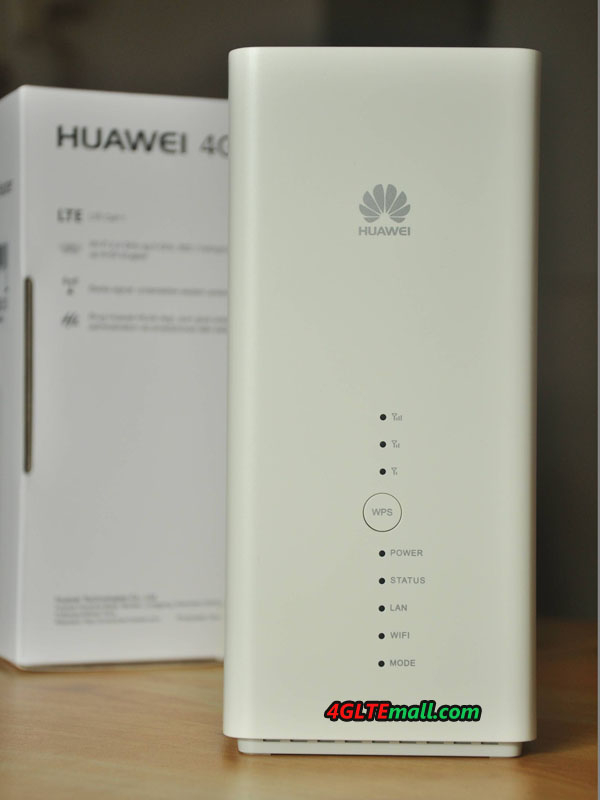
Huawei B618 B618s-22d front logo and indicators


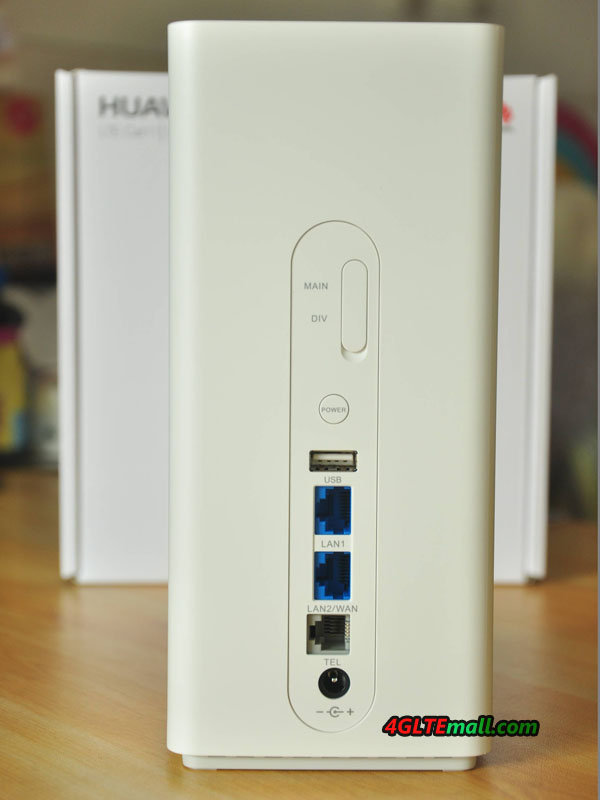
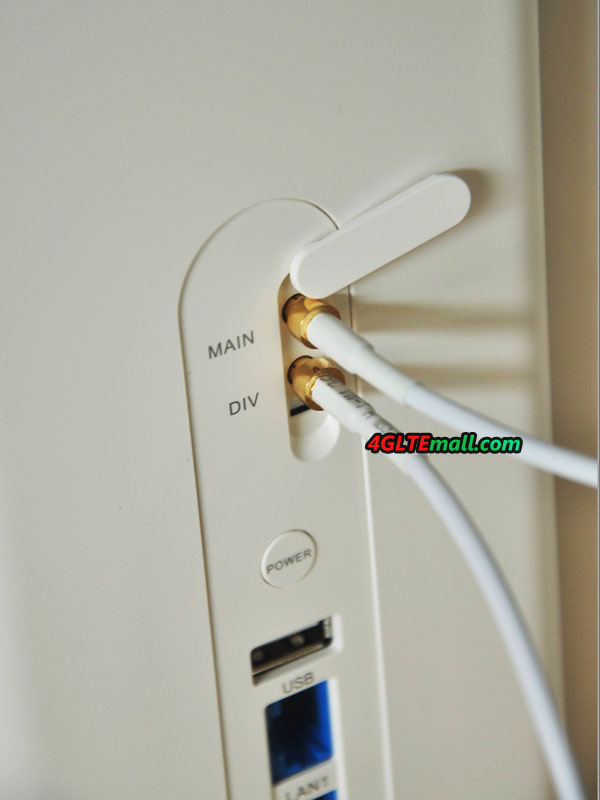
Huawei B618: Technical Specifications at a glance The Huawei B618 offers very good technical equipment and a cube design in white high-gloss plastic body. On the front, there are various LEDs and a WPS button, on the back two RJ45 Gigabit LAN connections (one also as WAN usable), an RJ11 telephone connection and a connection for the power supply. There are also two TS-9 connectors for an external LTE antenna and a USB 2.0 connector.


Huawei B618 B618s-22d USB LAN WAN Telephone ports


Inside the Huawei B618, there is a HiSilicon Balong 750 modem that supports LTE Category 11 (Cat11) with up to 600 Mbps downlink and up to 50 Mbps uplink. All key technologies for 4.5G LTE Advanced Pro can be found in the Huawei B618: 256QAM modulation, carrier aggregation and even 4 × 4 MIMO antenna technology there. Vodafone was the first provider in Germany to officially announce the use of 4 × 4 MIMO technology for LTE, so the Huawei B618 should ideally be suitable for the Vodafone LTE advanced Pro network. The WLAN module allows the connection to a maximum of 64 WLAN devices at the same time and works in both the 2.4 GHz band and the 5 GHz band.


Huawei B618 B618s-22d external antenna connector


The Huawei B618s-22d is the European version of the B618 and the unlocked Huawei B618s-22d has been available on www.4gltemall.com since July 2017. You can use the unlocked B618 with almost all the network providers in Europe. Anyone who needs a high-level home router, the Huawei B618 is highly recommended due to the multiple practical functions. Since many network providers have not upgraded their network to LTE advanced Pro, the Huawei B618 may be too early to use and currently, the price for Huawei B618 is in high level, the Huawei E5186s-22a is still good to use on LTE cat.6 for download speed to 300mbps and upload speed to 50mbps. The most important is the price for Huawei E5186 is really budget now.  


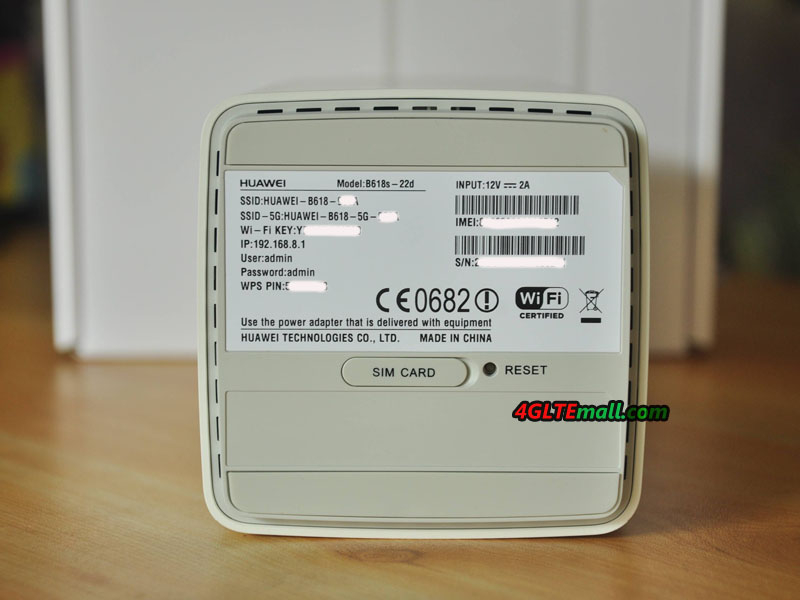
Huawei B618 B618s-22d bottom label


2017年11月15日 星期三

Huawei B715 B715s-23c 4G LTE Cat.9 Wireless Router

Huawei B715 B715s-23c 4G LTE Cat.9 Wireless Router


* LTE Category 9 wireless CPE


* LTE DL 450Mbps/UL 50Mbps


* Built-in DHCP Server, DNS RELAY and NAT


* 4 x LAN ports(One for LAN/WAN), 1 x telephone port


* Two connectors for external antenna


* Support up to 64 wireless devices


* WiFi 802.11b/g/n/ac, dual band

2017年11月14日 星期二

Huawei Mate 10 Pro First Impression

The Huawei Mate 10 Pro is the new flagship smartphone from Huawei. It comes in a new glass design and with a high-resolution 18: 9 display in three different colors now. In addition: a dual camera with f1.6 aperture, 128GB of internal memory and a modern Kirin 970 chipset with Neural Processing Unit (NPU). The LTE Cat18 modem can reach up to 1.2 Gbit/s in the download. The price for the Huawei Mate 10 Pro is quite fair compared to other flagship smartphones such as the Apple iPhone X or the Samsung Galaxy Note 8. Today we will take a closer look at the Mate 10 Pro smartphone, and show its details in this article.
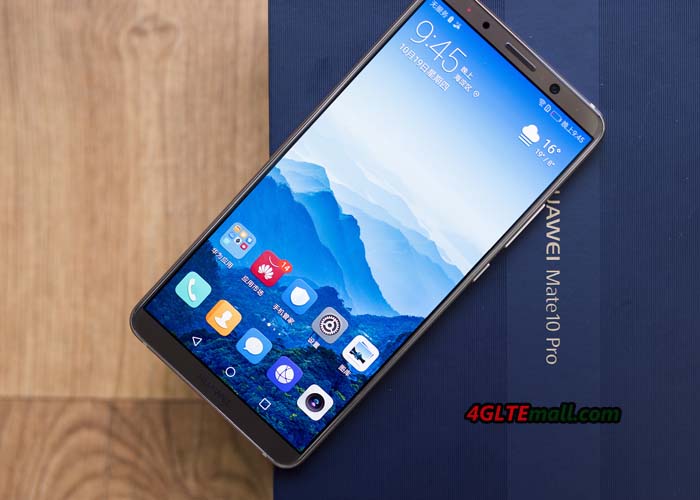


Glass body and large OLED display


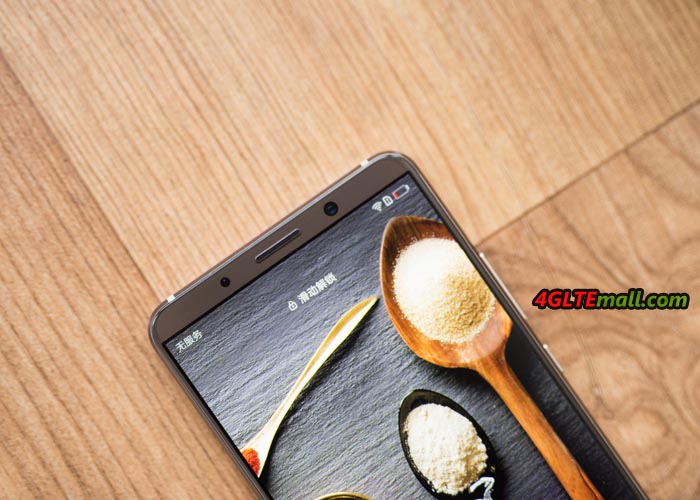
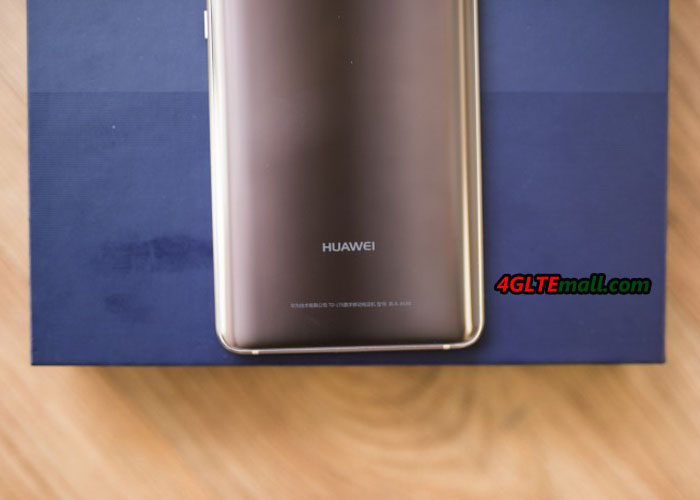
The Huawei Mate 10 Pro comes with a completely new design compared to its predecessor Huawei Mate 9. The earlier metal back was replaced by a glass back, which is clearly perceptible on all sides. As a result, the Mate 10 Pro is in the palm of your hand thanks to the 18: 9 formats (formerly 16: 9). In the display, Huawei sets a nearly borderless 6 inch OLED, which left a very good impression during the first test. The resolution is 2160 x 1080 pixels.


Kirin 970 chipset with LTE Cat18 support


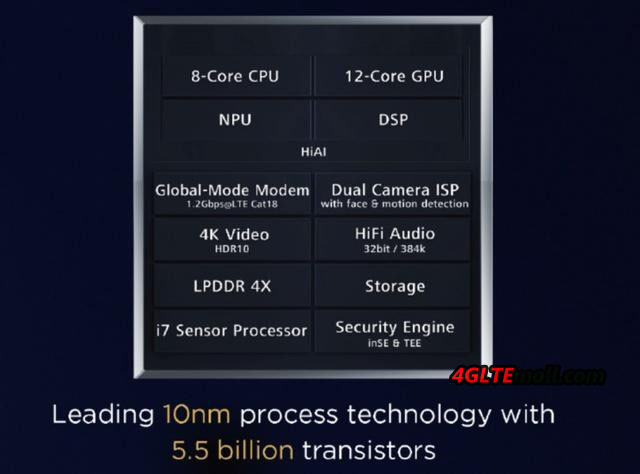
One of the highlights besides the integrated Leica dual camera is surely the HiSilicon Kirin 970 chipset. In addition to an octa core processor with 4 x 2.36 GHz and 4 x 1.8 GHz, this also offers a super-fast LTE modem for data rates of up to 1.2 GBit/s (LTE Advanced Pro category 18). The modem can bundle up to 5 frequency bands (5CC Carrier Aggregation ) and can use the 256QAM modulation. In addition, the Huawei Mate 10 Pro is one of the first smartphones with 4 × 4 MIMO antenna technology. The number of supported frequency ranges can also be seen, the device can be used worldwide:

  • LTE (FDD): B1 / B2 / B3 / B4 / B5 / B6 / B17 / B18 / B19 / B20 / B26 / B28 / B32
  • LTE (TDD): B34 / B38 / B39 / B40 / B41 (2545 ~ 2655 MHz)
  • UMTS (3G): B1 / B2 / B4 / B5 / B6 / B8 / B19
  • GSM (2G): 850/900/1800/1900


The Huawei Mate 10 Pro is the first smartphone to support Gigabit LTE networks.


Huawei Mate 10 Pro Software: Android 8 and EMUI 8


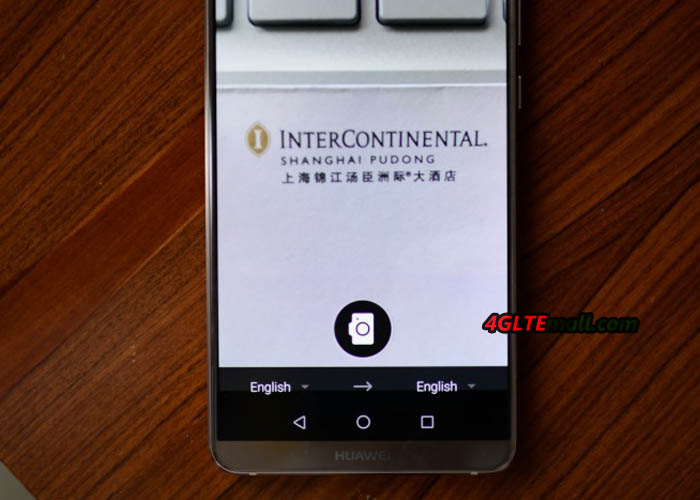
The Huawei Mate 10 Pro comes with the operating system Android version 8. The interface is pre-installed with EMUI 8.0, the latest version of the Huawei launcher. According to Huawei, the EMUI version number has skipped some numbers so that the version numbers of Android and EMUI are now identical. In the first test, the software ran smoothly, as you would expect. For easier one-hand operation, EMUI 8.0 has integrated a further improved "Floating Dock" functionality with a "virtual joystick" for the Mate 10 Pro.  


Camera with NPU support


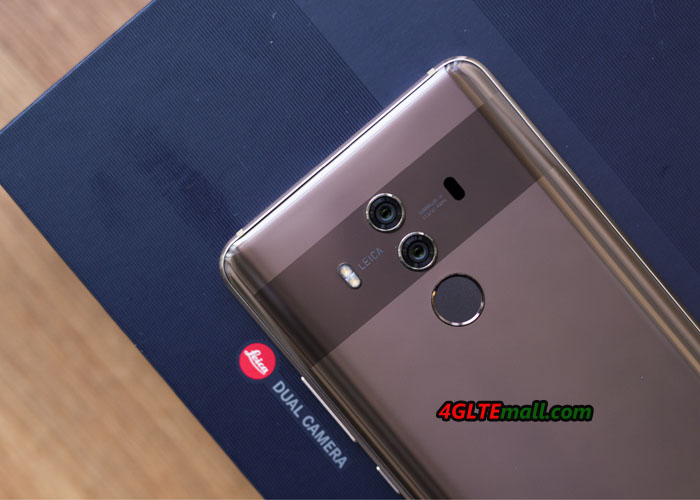
The Mate 10 Pro is equipped with a dual camera, which was developed in collaboration with Leica like the predecessor. There is an RGB sensor with 12 megapixel resolution and a black and white sensor with 20 megapixel resolution. According to Huawei, the Mate 10 Pro can take very good photos even in low light conditions thanks to the f1.6 optics. In the first test, the pictures really made a good impression, but for exact results one should of course wait for the detailed tests.


According to Huawei, the NPU ("Neural Processing Unit") of the Kirin 970 chipset ensures a very fast detection of content in the camera image and adjusts accordingly the appropriate camera mode, if desired. In the first test this worked surprisingly well. Videos will be recorded on request in 4K resolution with a maximum of 30 fps, 4K with 60 fps, as supported by the new Apple iPhone 8, while the Mate 10 Pro cannot. The front camera takes photos with up to 8 megapixel resolution and offers an f2.0 aperture.  



Internal memory without expansion capability


The Huawei Mate 10 Pro comes with 6 GB memory as well as 128 GB internal memory. The memory is very generous compared to many competitors models, but the Mate 10 Pro unfortunately cannot expand the memory via MicroSD card. Why Huawei has saved the slot is a mystery because space would probably have been there, especially since also dual SIM is supported.


Further technical data


The battery of the Huawei Mate 10 Pro offers a capacity of 4,000 mAh, it is not interchangeable by the user. The Huawei SuperCharge quick charge function is supported, meaning in a very short time you can recharge the battery.  Since the Mate 10 Pro does not have a 3.5mm jack and cable-connected headphones can only be connected via USB Type C, an adapter from USB Type C is included in the 3.5mm jack plug. A protective cover is included as well.


Huawei Mate 10 Pro: many strengths and few weaknesses


The Huawei Mate 10 Pro has left a good first impression. The device is good in the hand thanks to 18: 9 display format and the glass case. Only the many fingerprints, which are visible after a short time of use, disturb the design somewhat. The built-in technology makes a very good impression, here one can criticize only the missing MicroSD slot as well as the missing 3.5mm jack connection.  


The device is offered in the colors Titanium Gray, Midnight Blue and Mocha Brown. It’s said many network providers would introduce the Huawei Mate 10 Pro to their plan. Here now, the unlocked version Huawei Mate 10 Pro is available on www.4gltemall.com , you may contact us if you need it.

Vodafone R230 LTE Cat.9 Mobile WiFi Hotspot

Vodafone R230 LTE Cat.9 Mobile WiFi Hotspot


* LTE Category 9 mobile hotspot


* Chipset: Qualcomm MDM 9240


* Support GSM/EDGE/3G/HSDPA/LTE Cat9 network technology


* LTE DL 450Mbps/UL 50Mbps


* Non-removable battery of 2200mAh


* WLAN: 802.11b/g/n/ac, 2×2 MIMO


* Support up to 32 wireless devices

2017年11月13日 星期一

Vodafone Launches Gigabit LTE with 4 × 4 MIMO

Vodafone is the first German mobile network operator to announce the launch of LTE with gigabit speed and promises the launch of the first smartphone with Gigabit LTE modem in the market. Up to now, data rates of up to 500 MBit/s were possible in the Vodafone network, the speed is now doubled with the new 4 × 4 MIMO antenna technology. Gigabit LTE is now available in Berlin, Hamburg, Hanover and Düsseldorf, further cities are to follow according to Vodafone.


Gigabit LTE: new network technology for faster speed


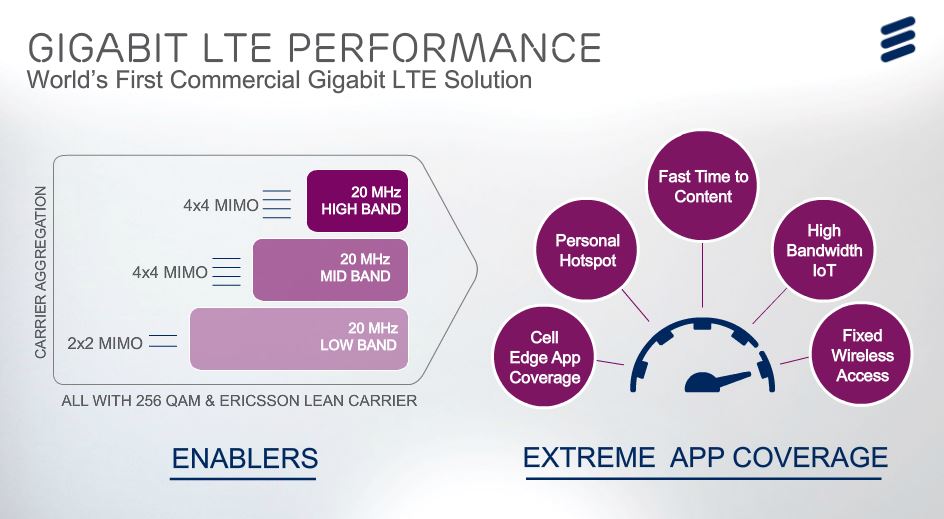
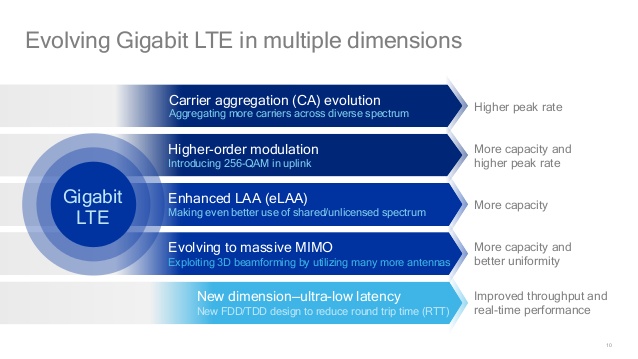
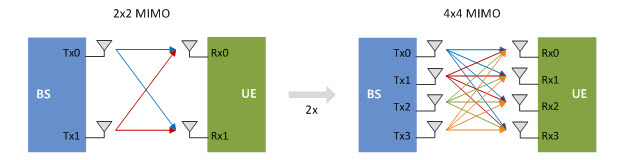
Vodafone combines several different technologies to achieve gigabit data rates in the LTE network. Thus, on the one hand, Carrier Aggregation (Channel bundling) is used to bundle different frequency ranges and thus make a larger radio spectrum available to the terminal. Vodafone currently uses 3CC (3CA) with band 3, 7 and 20 (800, 1800 and 2600 MHz), but in the future LTE will also be used on 2100 MHz (band 1), so that 4CC CA and 4CA it is possible. The second technology for increasing the speed in the downlink is the 256QAM modulation. Last but not least, the 4 × 4 MIMO antenna technology is now supported at the locations with Gigabit LTE, which means that it is sent and received twice as many antennas as before. To date, 2 × 2 MIMO antennas have been common.


Gigabit LTE is only available in a few locations


According to Vodafone, the first cities with Gigabit LTE supply are Düsseldorf, Hamburg, Hannover and Berlin, more cities to follow. However, the high speed is not available at every transmitter; rather Gigabit LTE will only be developed in places with very high data traffic, also to increase the capacity in the network. A comprehensive expansion is not worthwhile for the operator, since for Gigabit LTE a very high transmitter density is necessary.


Gigabit LTE can only be used with a new terminal


If you want to use the full Gigabit in the download also on the smartphone, you need a new device, which can support at least LTE category 16 (LTE Cat16). In addition, the smartphone must possess 4 × 4 MIMO antenna technology, as well as 256QAM modulation and at least three-fold carrier aggregation. If one of the features is not supported, then the speed drops dramatically: 256QAM modulation increases the speed compared to the 64QAM modulation by 33%, 4 × 4 MIMO increases the speed by 50% compared to 2 × 2 MIMO.


Here now, there is Netgear Nighthawk M1 MR1100 Gigabit LTE Router is available in Australia for network provider Telstra, but you can get unlocked Netgear Nighthawk M1 from www.4gltemall.com so as to use in Germany and other European countries. It’s a Gigabit mobile hotspot for a group of people. If you want to use the stationary router for the Vodafone Gigabit LTE network, the lastest Huawei B618s-22d 4G Router is also recommended.


And Huawei had recently released the new flagship smartphone Huawei Mate 10 and Mate 10 Pro would support the Gigabit LTE networks. These are the more latest wireless terminals for the LTE advanced pro networks. We suppose there will be more and more gadgets for the LTE-A pro. And we will keep updating on www.4gltemall.com/blog.    

2017年11月10日 星期五

LTE-Advanced Technology: Carrier Aggregation

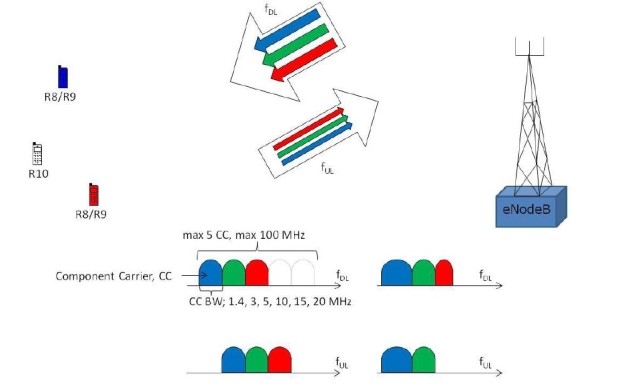
In this article I would like to explain the concept or the technology carrier aggregation in connection with LTE. Carrier aggregation, in short CA , is an important component of the 3GPP release 10, and thus of LTE-Advanced ( LTE-A ), which was specified in 3GPP Release 10. LTE-A consists of several components, including CA, for example 8 × 8 MIMO, and LTE UE categories 6, 7 and 8.


In addition to a higher speed (up to about 1.2 gigabits per second downstream in LTE cat. 8 UE) compared to normal LTE, improved data rates on the cell edge are also a plus for LTE-A. However, in spite of various optimizations, one will need more frequency spectrum in the future in order to be able to further increase the data rates and meet the increase in global traffic - the peak data rates of LTE-A can only be achieved if up to 100 MHz are bundled. And this is where Carrier Aggregation is used. Problem: Frequency spectrum is a scarce resource  


The topic affects almost all mobile network operators in the world: they do not have enough coherent frequency spectrum to easily offer the high data rates of LTE-A. In Germany, for example, there is only 20 MHz bandwidth available in the frequency range around 800 MHz - paired in 4 blocks, ie 10 MHz for the downlink and 10 MHz for the uplink. In the configuration currently in use (2 × 2 MIMO, LTE UE Cat. 3), a maximum of 75 MBit/s can be reached in the downstream, although not much more than 60 MBit/s is possible.  


Fortunately, the providers in Germany have enough spectrum to be able to connect at least LTE cat. 4 with up to 150 MBit/s without much effort, at least in the frequency ranges around 1800 MHz and 2600 MHz. It is only more difficult if higher speeds are desired. In other countries, such as South Korea, for example, there is already this problem, where carrier aggregation is used. Before I get to the details of this technology, first a short video from the company Qualcomm, which explains the functionality in a quite appealing way: [embed]https://youtu.be/SCbN1DgF60g[/embed]    


Carrier aggregation: bundling of different frequency  


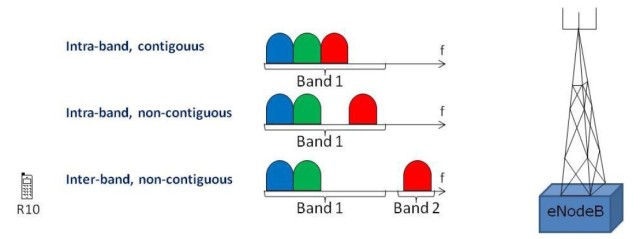
Blocks with CA, the network operators are able to bundle different frequency blocks into a large block for the first time. After 3GPP release 10, the upper limit is at 100 MHz, although a later expansion is of course not excluded. In the medium term, however, it is likely to be a bundling of 40 to 60 MHz.   There are three different modes for channel bundling, whereby only the following carriers can be combined: 1.4 / 3/5/10/15/20 Megahertz. How and in what way the combination takes place is left to the network operator, but maximum of 5 carriers can be bundled:


  • Intra band, contiguous:  this is the simplest CA method. Two or more frequency blocks are clustered, contiguous and within a frequency range (Intra band). So, for example, 2x 10 MHz in band 3 (frequency range around 1800 MHz). The terminal does not need any great hardware changes because it perceives the aggregated channel as a large channel and therefore requires only one transceiver (transceiver).


  • Intra band, non-contiguous: in this method, two or more carriers are bundled, these frequency blocks being not adjacent but lying in the same frequency range. On the end of the terminal, two or more transceivers are now required to use the aggregated band.


  • Inter-band, non-contiguous: this CA method is likely to be the most widely used in the future as it is most likely to be true for network operators. In this case, frequency blocks from different frequency ranges can be bundled in order to create the largest possible frequency block. A possible scenario would be, for example, the combination of spectrum from band 20 (around 800 MHz) with spectrum from band 3 (1800 MHz). As you can imagine, several transceivers and further optimizations are necessary in the terminal, which can have a noticeable effect on the energy consumption.


Different ranges of individual carriers and downwards compatibility  


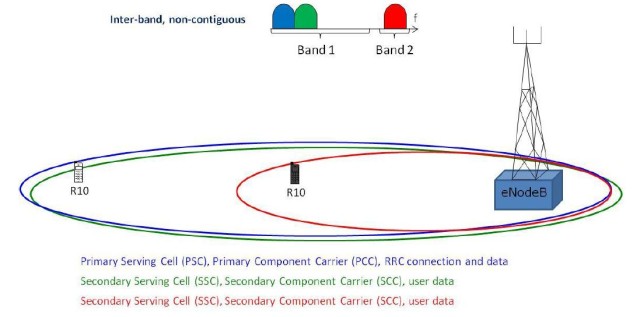
Especially in the case of carrier aggregation using inter-band, non-contiguous, it is inevitable that there will be differences in the size of the individual cells. Thus, with a terminal with CA support close to an LTE transmitter (eNodeB), very high speeds will be achieved as the terminal can use a lot of bundled spectrum. A few kilometers from the transmitter is possibly only LTE800 receivable and CA brings no more advantage.


As can be seen in the above, there is always a Primary Serving Cell, or PCC, a "main cell", which ensures the supply. The other cells (SCC) serve merely as a support for user data, in other words to increase the bandwidth. Depending on the terminal, the PCC can be different, depending on various factors, for example the respective energy consumption in the terminal. This, of course, requires a lot of optimization both in the network planning and in the manufacturers of the modems for mobile devices.  


Of course, CA and thus also LTE-A is down-compatible with "conventional" LTE. Old and currently available terminals are therefore still usable in the future. Nevertheless, if you want to use the higher bandwidths or carrier aggregation, you obviously need a new terminal. Here, again, the LTE UE category has to be considered, CA alone is not enough to achieve speeds in the gigabit range.